Oct 21 2013
Bombardier receives award from the AME | ept
See on Scoop.it – lean manufacturing
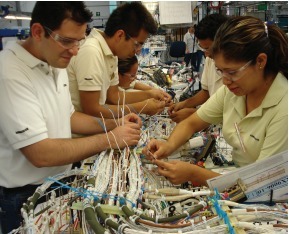
When evaluating Bombardier’s Toronto site, the AME assessment team was impressed by the use of improvement tools, especially with regards to the organization’s approach to Standardized Problem Solving and an empowerment system called Xcell. Combined, these processes drive continuous improvement and engagement by the workforce down to the shop-floor level. Equally impressive to the team was the level of accountability at Bombardier’s Toronto Site and an understanding that the entire organization must change to meet evolving demands and new visions.”
According to this article, the AME recognized Bombardier as having implemented Lean Manufacturing on the basis of having Standardized Problem Solving and an individual suggestion system called Xcell.
Is that it? I have to assume that Bombardier has done a few other things to improve quality, productivity, delivery, safety, and morale, including perhaps designing production lines for flow, reducing setup times, implementing a pull system with heijunka, mistake-proofing manual operations, setting up work teams with job rotations, …
What did they actually do and how well did it work? The article does not say.
See on www.ept.ca





Oct 24 2013
Toyota Lagging in Part Standardisation and Platform Sharing | Autocar
See on Scoop.it – lean manufacturing
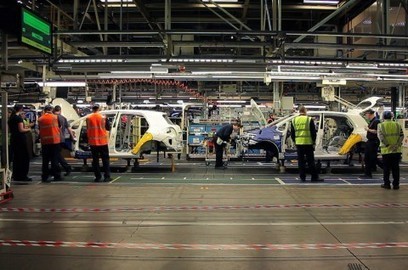 “Kanban-style just-in time parts deliveries, kaizen policies of continuous improvement – Toyota has been a banner-carrier for these and many other methodologies that long ago gave it an edge when it comes to productivity and robust, repeatable quality.
So it’s a bit of a surprise to hear, as we did last week in Toyota’s Nagoya headquarters, that the company has been a bit less effective when it comes to parts standardisation, platform sharing and common parts strategies.”
I was taken aback by the article’s original title, describing Toyota as a “master of mass production,” but read on nonetheless and found the rest intriguing.
In essence, it asserts that Toyota paid for the autonomy of its product development teams in the form of too many different parts and platforms, and is undertaking to change this for the future.
The article does not say how Toyota proposes to do it.
See on www.autocar.co.uk
Share this:
Like this:
By Michel Baudin • Press clippings 0 • Tags: Common platforms, Part standardisation, Toyota