Sep 13 2013
A defense of old-fashioned WIP accumulation | Manufacturing Digital
See on Scoop.it – lean manufacturing
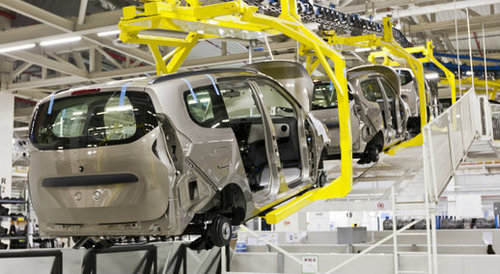
The gist of this article is that you should hold just enough WIP to meet your production requirements with the changeover times you currently have and protect your bottlenecks against malfunction in other resources. So far, this is stating the obvious, and a visit to a Toyota plant or even dealership is enough to see that the Toyota system is not one with zero inventory. You see shelves of stampings, bins of bolts, and trees of wire harnesses. The Kanban system involves some inventory, and, in fact, the only approach that doesn’t is just-in-sequence. What is considered waste is not all inventory, but unnecessary inventory, accumulated for no valid reason anyone can explain.
The article, however, goes further and asserts that it is cheaper to accumulate WIP than to expose and solve the problems that make it necessary, which is a return to the mass-production thinking that was prevalent in pre-Lean operations management.
What the Lean successes of the past decades have shown is (1) that the overall costs of WIP were understated and (2) that the ingenuity of production people and engineer was underestimated. You operate today and next week with the resources that you have, dysfunctional as they may be, and you hold WIP as needed to sustain production. As you do this, however, as an organization, you keep working at solving your problems so that you need less and less WIP month by month and quarter by quarter. This perspective is missing from the article.
See on www.manufacturingdigital.com





Sep 17 2013
What is Karakuri Kaizen?
Google “Karakuri Kaizen,” and you see a small number of Youtube videos from Japan, Thailand, Italy, and Hong Kong showcasing materials handling devices that rely on gravity, levers, cams and inertia to move bins in elaborate ways, transfer parts between machines, or deliver a controlled number of small parts to an operator’s hand.
Here is one from Japan’s JMAC with multiple examples:
Such devices have long been used as part of TPS and Lean, but now we have a generic name for them. The principles of Karakuri Kaizen given at the end of this video are as follows:
While “Karakuri Kaizen” is an alliteration that rolls of the tongue almost as easily as “cash for clunkers” or “toys for tots,” you may still wonder where “Karakuri” comes from and what it means. Until “Karakuri Kaizen,” I had never heard it stand-alone but always as part of “Karakuri Ningyo,” or Karakuri Dolls, which are wind-up automata with wooden gears and levers developed at toys in 18th-century Japan. The best known are tea-serving dolls, like the one in the featured image.
As Karakuri dolls are a reminder of ancient ingenuity, the term has a positive connotation in Japan. I once used a picture of one in a magazine ad for US-made automation software, to connect the product with the local culture. But the term, obviously, means nothing to anybody who is not Japanese.
Share this:
Like this:
By Michel Baudin • Technology 6 • Tags: Autonomation, jidoka, Karakuri, Lean, TPS