May 29 2013
Using videos to improve operations | Part 2 – Management Preparation
Whether on the shop floor or elsewhere, starring in a video makes people nervous, particularly when they don’t know how it will be used and when it is done by strangers. On the shop floor, particularly when unions are present, operators fear that the videos recordings will simply be used against them and to justify layoffs. Unless these fears are put to rest before the shoot, it will be tense and, if it happens at all, the quality of the data will be affected.
Following are key steps to follow:
- Have a clear objective. Videos can be used for many purposes:
- Setup time reduction. This is the most common current use in Lean implementation.
- Work Sampling. A time-lapse video of a work area can be used as a series of snapshots on which to count the people and machines by category of activity, providing rough estimates of proportions of time spent walking, waiting, carrying parts, processing work pieces, etc.
- Analysis of team coordination. You record from a distance the movements and state changes of multiple people and machines. You don’t see the details of what each one does, but you identify situations where they:
- Walk long distances, empty-handed or carrying heavy parts,
- Cause others to wait,
- Deadlock each other,
- Fix the work done by others,
- …
- Details of work done at an individual station. You focus on the hands of one operator through a sequence of steps at a work station, with the goal improving both individual steps and their sequencing.
- …
This is necessary not only to plan the shoot so that the video supports the objective, but also to identify the people who will be recorded and the ways in which the analysis may affect them.
- Secure the consent of the participants. The people recorded in the video are not the object of a project but participants in it. It should only be done if they and their management agree. This entails the following:
- Review the project with the direct supervisor of the area first, and proceed only if he or she supports it. The supervisor needs to agree to let operators participate in video analysis sessions, during work hours if they can be temporarily replaced in production, and in overtime otherwise.
- If the plant is unionized, review the project with the union leadership. Unless prevented from doing so be constraints external to the plant, unions support the project once they are reassured that:
- The purpose is not to make people work harder.
- It is no threat to job security.
- It usually improves safety.
- Review the project with the operators, in the presence of their supervisor and a union representative if applicable.
- There must be a clear policy on the handling and dissemination of videos after the analysis. The principle to follow is that what happens on the shop floor stays on the shop floor. The videos are not to be shared with any outsider to the project. VHS cassettes were easy to safeguard; MPEG files on hard disks are a different challenge. They need to be organized in a video database with proper indexing and safeguards, which is a whole other subject.


May 30 2013
Ohno Disciple Led Earthquake Recovery in Semiconductor Plant| The Truth About Cars
See on Scoop.it – lean manufacturing
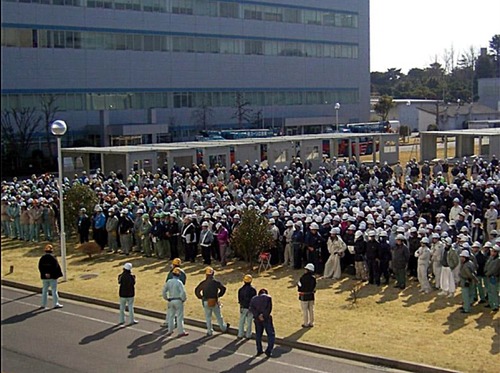
“After the March 11 monster earthquake and tsunami wiped out large parts of Japan, headlines focused on the near-meltdown of Fukushima. Recently, I learned that there was a strong likelihood of a worldwide economic meltdown, caused by a microchip factory 80 miles south of Fukushima. Here is the story of how the crisis was contained.
‘I was already retired when the earthquake came,’ remembers a Toyota official who requested that his name is not published. He is a seasoned production expert, one of the few alive who received personal training from Taiichi Ohno, the father of the Toyota production system. ‘I thought, let others handle the problem, but I was wrong.’ He was recalled and asked to spearhead the Toyota part of the reconstruction effort.”
While critics have often claimed that low inventories made Lean supply chains vulnerable to natural disasters, Toyota’s record in actual events says otherwise, in cases including, in the US, the Mississippi flood of 1993 and, in Japan, the Aisin Seiki fire of 1997 and now the Fukushima earhquake of 2011.
As it turns out, the combination of vigilance in logistics and relationships that make it possible to enlist the supply chain in rapid recovery works better than inventory. In the case of the Fukushima earthquake, more inventory would simply have meant more losses.
See on www.thetruthaboutcars.com
Share this:
Like this:
By Michel Baudin • Press clippings 0 • Tags: Disaster recovery, Fukushima earthquake, Lean supply chain, Toyota, TPS