Oct 18 2013
When Bad Things Happen to Good Supply Chains | Industry Week
See on Scoop.it – lean manufacturing
“Any single failure anywhere in the supply chain can bring operations and profits to a standstill. From the 2011 tragedies of the Tōhoku earthquake and tsunami in Japan to last year’s devastating Hurricane Sandy closer to home, Mother Nature has a way of reminding us to reexamine catastrophe preparedness.
These events, and the tragic aftermath that follows, also serve to remind the insurance industry of the challenges in quantifying risk and accounting for exposure in an increasingly complex supply chain environment. As a result, risk managers are being asked new questions as insurance underwriters require them to seek information from a broader range of stakeholders within and outside of their organizations.”
The article is limited to a list of questions an insurer might ask about a supply chain, some of which cannot be pratically answered. The supply chain management literature often states the need to know your suppliers’ suppliers and your customers’ customers, but most companies don’t, and practically can’t.
After all, the point of buying from suppliers is to delegate responsibility for the whole upstream supply chain. If you have to worry about it all the way to mining raw materials out of the ground, you might as well make it all in-house from scratch, like at Ford’s River Rouge plant in the 1930s.
Asking the right questions is fine, but providing answers is better. Supply chain disruptions come in many degrees of severity and a variety of frequencies, from trucks delayed by traffic accidents to earthquakes and tsunamis.
You can, and should have preplanned responses to small, frequent disruptions. That may involve building some slack in milk run schedules, keeping small buffers of stocks, or having contingency plans for alternative transportation…
But you cannot practically have preplanned responses to all possible catastrophes. What you need is to monitor operations with vigilance to get early warnings, and develop relationships with your suppliers and customers that are strong enough that they come together and develop an ad-hoc, rapid response when disaster strikes.
This is the lesson I see in Toyota’s response to emergencies, from the Mississippi flood of 1993 to the Aisin Seiki fire of 1997 and the Fukushima earthquake of 2011.
See on www.industryweek.com

Oct 24 2013
Toyota Lagging in Part Standardisation and Platform Sharing | Autocar
See on Scoop.it – lean manufacturing
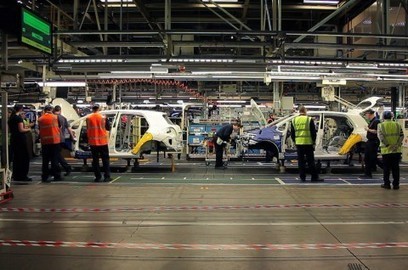 “Kanban-style just-in time parts deliveries, kaizen policies of continuous improvement – Toyota has been a banner-carrier for these and many other methodologies that long ago gave it an edge when it comes to productivity and robust, repeatable quality.
So it’s a bit of a surprise to hear, as we did last week in Toyota’s Nagoya headquarters, that the company has been a bit less effective when it comes to parts standardisation, platform sharing and common parts strategies.”
I was taken aback by the article’s original title, describing Toyota as a “master of mass production,” but read on nonetheless and found the rest intriguing.
In essence, it asserts that Toyota paid for the autonomy of its product development teams in the form of too many different parts and platforms, and is undertaking to change this for the future.
The article does not say how Toyota proposes to do it.
See on www.autocar.co.uk
Share this:
Like this:
By Michel Baudin • Press clippings 0 • Tags: Common platforms, Part standardisation, Toyota