Nov 21 2011
An Alternative to Kanban: One-Piece Continuous Flow
Via Scoop.it – lean manufacturing
This is a guest post by Jim Coplien on Jeff Sutherland’s blog. Jim’s research seems thorough
Via scrum.jeffsutherland.com
Nov 21 2011
Via Scoop.it – lean manufacturing
This is a guest post by Jim Coplien on Jeff Sutherland’s blog. Jim’s research seems thorough
Via scrum.jeffsutherland.com
Nov 19 2011
Via Scoop.it – lean manufacturing
The article Lean Manufacturing: Measuring To Get Results by Gerald Najarian lists a number of useful metrics. It also opens with the saying, or cliche, that “you get what you measure.”
The implications are (1) that people will always do whatever it takes to maximize their metrics, and (2) that, if you put the right metrics in place, improvement will take care of itself. While I agree that we need good metrics, we should not overestimate their impact. Peer pressure and personal ethics, among other factors, drive most people more than their performance metrics. And even when employees do their utmost to maximize their scores, they often do not have the necessary skills, and performance targets will have no effect unless backed up by some form of training, coaching and support.
Via ezinearticles.com
Nov 18 2011
Via Scoop.it – lean manufacturing
An important milestone in automotive manufacturing is taking place with Toyota’s celebrated Georgetown plant marking its 25th anniversary on Monday.
Via www.kentucky.com
Nov 15 2011
Via Scoop.it – lean manufacturing
Dave Westphal’s 13-year-old daughter, Rachel, is a competitive figure skater. She is also the inspiration for a manufacturing improvement initiative at Nexteer Automotive, a leading US-based maker of steering and driveline systems for the car industry, where her father is director of lean manufacturing.
Via www.ft.com (You have to register on the Financial Times site to retrieve it, but a free registration will do.)
Video technology is now so pervasive that it is nearly impossible to buy a phone that does not include a camera capable or recording footage that is good enough for broadcast news. Journalists use amateur videos to show storm damage or expose human brutality. We use it to identify improvement opportunities in business operations.
As is obvious from watching the Gilbreth films, where Taylor measured in order to control, the Gilbreths observed in order to improve. Taylor’s greater fame or notoriety, however, obscured this fundamental difference in the public mind, and made workers as wary of cameras as of stopwatches.
According to psychologist Arlie Belliveau,”The Gilbreths used workers’ interest in film to their advantage, and encouraged employees to participate in the production and study of work through film. Participants could learn to use the equipment, star in a film, and evaluate any resulting changes to work practices by viewing the projected films in the labs or at foremen’s meetings. Time measurements were made public, and decisions regarding best methods were negotiated. By engaging the workers as participants, the Gilbreths overcame some of the doubt that followed Taylor’s time studies.” In other words, these pioneers already understood that, unlike the stopwatch, this technology enabled the operators to participate in the analysis and improvement of their own operations.
Until recently, however, the process of recording motion was too cumbersome and expensive, and required too much skill, to be massively practiced either in manufacturing or in other types of business operations. In addition, most managements failed to use it in as enlightened a way as the Gilbreths, and manufacturing workers had a frequently well-founded fear that recordings would be used against them. As a consequence, they were less than enthusiastic in their support of such efforts.
Setup time reduction is probably the first type of project in which it was systematically used, first because the high stakes justified the cost, even in the 1950s and second because its objective was clearly to make drastic changes in activities that were not production and not to nibble a few seconds out of a repetitive task by pressuring a worker to move faster.
Technically, the cost of shooting videos has not been an issue since the advent of the VCR in the 1980s. Analyzing a video by moving forward and backwards on a cassette tape, while it appears cumbersome today, was far easier than dealing with film. The collection of data on electronic spreadsheets also eliminated the need to use counterintuitive time units like “decimal minutes.” Adding columns of times in hours, minutes and seconds was impractical manually but not a problem for the electronic spreadsheet.
With videos now recorded on and played back from flash memory, and free media-players as software, not only is moving back and forth in a video recording is easier, but the software maps video frames to the time elapsed since the beginning. We could manually transfer timestamps read from the bottom of the video player software window into electronic spreadsheets and have the spreadsheet software automatically calculate task times as the differences between consecutive timestamps.
While this approach has been a common practice for the past 15 years, video annotation software is available today, which helps break down the video into segments for steps, label them, categorize them, and analyze them.
You can also use it to structure the data and generate a variety of analytics to drive improvements or document the improved process through, for example, work instructions. Over the previous approach, video annotation has the following advantages:
“Video time studies” is too restrictive a name for what we do with videos. It implies that they are just a replacement for a stopwatch in setting time standards. But what we really do with videos is analyze processes for the purpose of improving them, and this involves more than just capturing times. The primary pupose of the measurements is to quantify the improvement potential to justify changes, and to validate that they have actually occurred.
Putting this technology to use is not without challenges. Video files are larger than just about any other type we may use, be they rich text, databases, or photographs. And they come in a variety of formats and compression methods that make the old VHS versus Betamax dilemma of the VCR age look simple. More standardization would help, and will eventually come but, in the meantime, we have to learn more than we want to know about these issues. Functionally, the next technical challenge is the organization of libraries or databases for storage and retrieval of data captured in the form of videos. The human issues of video recording and analysis of business operations, on the other hand, remain as thorny as ever.
Nov 13 2011
Via Scoop.it – lean manufacturing
This article, called “When Lean Cuts Too Deep” fingers Kellog’s Lean program for weakening the company by cutting too many people. We must remind manufacturing professionals that Lean is a specific approach based on the results of over 60 years of development at Toyota, and cannot be blamed for the failings of any half-baked, hare-brained head-cutting scheme hatched by managers who choose to call it “Lean.”
Via www.manufacturing-executive.com

Nov 21 2011
Chaku-Chaku lines covered in the Manila Times today — When in the US press?
Via Scoop.it – Cellular manufacturing
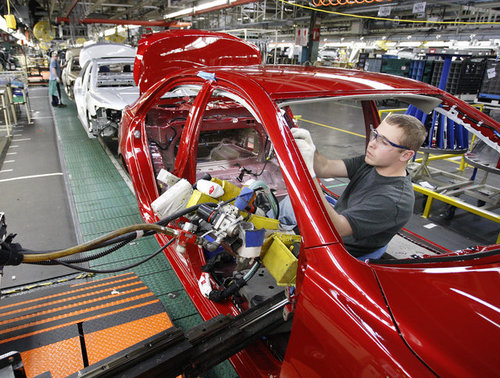
Chaku-chaku lines are the second generation of cells, allowing a single operator to run15 or even 20 machines. The key concept is for all the machines to have automatic unloading, so that the operator focuses on validating each step through go/no-go gauges and loading the workpiece into the next machine. It’s a concept that deserves more attention than it has received so far outside of Japan.
Via www.manilatimes.net
Share this:
Like this:
By Michel Baudin • Press clippings 0 • Tags: Cellular manufacturing, industrial engineering, Manufacturing engineering