Oct 2 2012
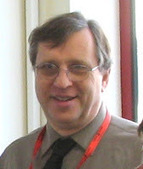
A Lean Journey: Meet-up: Michel Baudin
See on Scoop.it – lean manufacturing
Interview on Tim McMahon’s A Lean Journey.
See on www.aleanjourney.com
Oct 2 2012
See on Scoop.it – lean manufacturing
Interview on Tim McMahon’s A Lean Journey.
See on www.aleanjourney.com
Aug 13 2012
See on Scoop.it – lean manufacturing
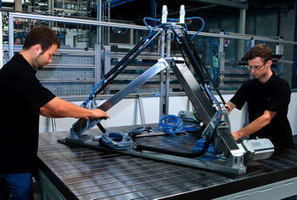
Festo has implemented a manufacturing system that allows it to produce parts for linear handling systems economically in batch sizes of just one item. At its global production centre for electric and pneumatic drives at St. Ingbert-Rohrbach in Germany, the company has introduced a “one piece flow” method of assembly, based on Toyota’s production system.
See on www.drives.co.uk
Jul 18 2012
See on Scoop.it – lean manufacturing
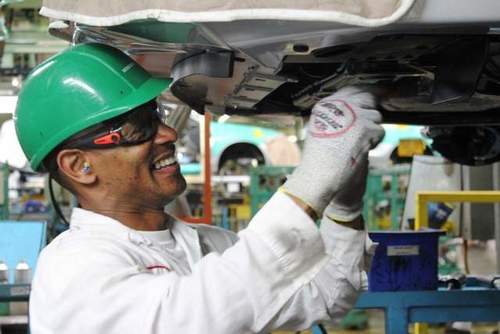
This article discusses the “renowned lean manufacturing and ‘just-in-time’ production techniques of the Japanese manufacturers,” a wording that implies that all Japanese manufacturers use variants of the Toyota Production System (TPS). It is not the case, and it is particularly not true of Honda.
Honda is good at manufacturing, but uses methods developed in-house, based on the founder’s philosophy of self-reliance.Soichiro Honda was known for telling engineers: “Don’t try to find out what the other guy is doing, just solve your own problem!” He also got the company involved in racing early on so as to infuse the “racing spirit” in everything it did. The Honda Way isn’t just a rebranding of TPS or Lean, as so many companies’ “Production Systems” are; it is an original, autonomous development. The white uniform in the picture is part of it. Its purpose is to make stains stand out, so that their sources are identified and removed from production.
See on www.detroitnews.com
Jul 17 2012
See on Scoop.it – lean manufacturing

It has become extremely popular for companies in any business to pursue the principles of lean production, Six Sigma, TQM, TPM etc (even if the two latter are a bit “so 90s”…) …
See on better-operations.com
Jul 17 2012
See on Scoop.it – lean manufacturing
Jeffrey Liker on what Lean really is. An interesting article, with which I have a few quibbles:
“At the end of the day U.S. manufacturers that invest in developing skilled, motivated leaders whose passion is to develop people who can improve processes in the long-term will beat the competition every time.”
I don’t think it’s true, because they will be competing against manufacturers elsewhere doing the same.
I also do not see this statement as an accurate summary of Lean. Under Alfred P. Sloan’s leadership in the 1920s, GM did everything the statement says. When Peter Drucker wrote Concept of the Corporation in 1946, GM was arguably the best run company in the world, particularly in leadership development, but, even looking back, you wouldn’t call it Lean.
See on www.manufacturingpulse.com

Oct 23 2012
TOC versus TPS
Thomas Spornberger, in the TPS Only group on LinkedIn, started a discussion on the following topic:
It has had 55 responses to date, to which I added my own this morning:
In 1986, I was trained by Eli Goldratt’s organization to implement their OPT production scheduling software, which was the first incarnation of TOC. My first project afterwards was to implement it in an aluminum foundry that produced castings for the auto industry, had 40% of its diecasting machines down at any time, and took 40 hours to change a dies in any of these machines. It was obvious that scheduling was the least of their worries, but it was what corporate management had decided to focus on.
As OPT was not a viable software product, Goldratt’s organization soon dropped it to focus on the “thoughtware” behind it, repackaged as TOC. I read The Goal at the time, and, later, Theory of Constraints, and found these theories simplistic and misleading. Simplistic because they fail to account for the variety of challenges facing manufacturing operations; misleading, because they make managers believe that you can make all the improvements you need without moving one machine or doing any engineering improvement. One point I remember from The Goal was focusing “setup men” on the bottleneck machine; the idea of improving setups so that they could be executed by production operators was not considered.
Most of the above comments, about balancing, heijunka, and kanban, are about assembly, and one key characteristic of assembly work is that it is almost infinitely divisible. You can break it down into elements that are as small as you want and reassign them between stations backwards and forwards. This is why an assembly line does not have bottlenecks, and a book on assembly does not need the word.
Machining and fabrication are a different story, because there are many cases where it is technically impossible to reassign work between machines. There are also enormous differences in cost between machines, for example between a drill press and a gear hobbing machine. As a consequence, a gear cutting cell has a bottleneck machine that you try to keep as busy as possible, and supporting machines that you try to make sure are available when needed but don’t care if they are used only 10% of the time.
Capacity planning and production scheduling in such a cell is centered on its bottleneck machine, but. on the scale of a cell, it is not complex. If the cell is dedicated to a product, it is trivial; if not, the key challenge is to achieve quick changeover for the entire cell so that it can support heijunka for the entire plant.
TOC is a one-trick pony. TPS is a system that addresses the full variety of manufacturing challenges found in the automotive supply chain, and it has been successfully adapted to other contexts with the “Lean” label.
Share this:
Like this:
By Michel Baudin • Blog clippings 1 • Tags: Lean manufacturing, TOC, Toyota Production System, TPS