Are you Lean, becoming Lean, doing Lean or thinking Lean? Almost the entire province of Saskatchewan has gone Lean. On the surface Lean offers everything front line workers should want. …
Lean is from Japan, and even more specifically from one Japanese company. Outside of Japan, however, the foreign origin of the concepts impedes their acceptance. In every country where I’ve been active, I have found the ability to link Lean to local founders a critical advantage. The people whose support you need would like to think that Lean was essentially “invented here,” and that foreigners at best added minor details. Identifying local ancestors in a country’s intellectual tradition takes some research, and then you may need to err on the side of giving more credit than is due.
Feeder line at Ford
In the US, using the word “Lean” rather than TPS is already a means of making it less foreign, and it is not difficult to paint Lean as a continuation of US developments from the 19th and 20th century, ranging from interchangeable parts technology to TWI. Ford’s system is a direct ancestor to Lean, as acknowledged by Toyota. On this basis, the American literature on Lean has gradually been drifting towards attributing Lean to Henry Ford. Fact checkers disagree, but it makes many Americans feel better.
Elsewhere, it is not as obvious to find a filiation. Following are a few examples of what I found:
Russia has Alexei Gastev, who started an industrial engineering institute in Moscow in 1920, was shot by Stalin in 1939 and largely forgotten afterwards, but our OrgProm colleagues have now named a prize after him, that is given to Russian companies for excellence in manufacturing. It was awarded for the first time in 2011. Here are, from 1924, Gastev’s 9 steps to automate a riveting operation:
Gastev’s 9 steps to automated riveting
Poland has Karol Adamiecki, whose “harmonogram” is the same as a Gantt chart, and was invented independently and a few years earlier. If you google “harmonogram,” you get pictures of Gantt charts. I am sure there must be some differences between the two, however minor, but I can’t tell what they are.
Italians can connect Lean to the shipyard in which Venetians assembled galleys in the Renaissance. Jim Womack identified it as a early flow line. As he wrote in Walking Through Lean History:
“… Dan Jones visited the Arsenal in Venice, established in 1104 to build war ships for the Venetian Navy. Over time the Venetians adopted a standardized design for the hundreds of galleys built each year to campaign in the Mediterranean and also pioneered the use of interchangeable parts. This made it possible to assemble galleys along a narrow channel running through the Arsenal. The hull was completed first and then flowed past the assembly point for each item needed to complete the ship. By 1574 the Arsenal’s practices were so advanced that King Henry III of France was invited to watch the construction of a complete galley in continuous flow, going from start to finish in less than an hour.”
Galley assembly hall in Venice
Britain, as the Olympic opening ceremonies reminded us, was home to the industrial revolution. In terms of worldwide share of market for manufactured goods, however, Britain peaked about 1870, and the thinkers that come to mind about British manufacturing are economists like Adam Smith or David Ricardo, whose theories were based on observations of early manufacturing practices, but whose contributions were not on the specifics of plant design or operations. They are too remote to be linked in any way to Lean.
For France, I have asked everybody I know there for nominations but have yet to receive any. The French have invented many products and processes, but I have not been able to identify French pioneers in production systems who could provide a link to Lean. And there are many other countries where the search may be fruitless.
Even though people in China and India have been making things for thousands of years,I don’t know any names of local forerunners of Lean in these countries. China has only emerged as a world-class manufacturing power in the last few decades and I have, unfortunately, never been to India. There are many other countries on which I don’t have this kind of information, and nominations are welcome.
See on Scoop.it – lean manufacturing
While most business books read like a 10-page article diluted over 200+ pages, Art Byrne’s, instead, reads like 600-pages condensed to 200. This is the right length to be read by business people on airplanes. A longer book could have given more details, but at the cost of losing the audience. As it is, behind every sentence, you sense that there is personal experience you would like to dig further into.
In the Lean CEO discussion group on LinkedIn, Paul Renoir started a discussion on why 5S implementations are not sustained. As one of the participants, Sammy Obara, pointed out, if it’s not sustained, by definition it’s not 5S. The discussion is really about why 5S fails, and failing it does, massively and systematically. Among the 22 contributions to this discussion to date, there isn’t a single one contradicting its basic premise, and asserting what a great success 5S has been in specific facilities.
What I have written on 5S in this blog before may make me sound as if I thought of it as worthless. It’s not the case. 5S is a valuable tool, and it is implemented with success in many factories in Japan. The failures that can be seen in the US and Europe are due to misunderstandings, translation errors, and wrong decisions as to when and why it should be implemented. My previous posts on the subjects are as follows:
Consultants often recommend that a company start with 5S for the wrong reasons. One quick look at a plant and you know that it would be better with 5S, but that doesn’t mean that 5S would solve its problems or that the organization is capable of implementing it.
It’s like a kid with problems at school who has a messy room. It’s easy to tell the kid to tidy up the room, but it won’t solve the problems at school, and it won’t be sustained. Whether with a plant or a kid, figuring out what the problems are takes more time and effort, but it is necessary if you want to identify projects (1) that put the organization on track to a solution, (2) that it has the skills and the will to conduct successfully, and (3) that entail changes that will be sustained.
Initial projects that work
Art Byrne, among others, recommend giving stretch goals to projects. The point of stretch goals is that they cannot be reached just by putting in extra effort temporarily. Instead, stretch goals require you to make substantial, physical changes to the work, including modifications of machines or fixtures. Once you have made such changes, not only do you achieve your stretch goals, but you don’t easily revert to the old way. In the initial stages of Lean implementation, the only way you get any 5S to stick is by making it the “finishing touches” on other projects, like cells or SMED. If, instead, 5S is the project, it won’t be sustainable.
5S and involvement by everyone
One aspect of 5S that is lacking in just about every discussion of it that I have seen in English is that, when you make 5S a project on its own, it must involve everyone. Participation is not on a voluntary basis. Everyone from the CEO to the janitor must participate, and it fails unless this actually happens. Most employees consider this cleaning up to be beneath them, and top managers’ direct participation is essential to prevent them from feeling this way and acting accordingly.
This is why 5S is so difficult to implement, especially as your first step towards Lean. On the other hand, if you have taken the content of 5S and, as I suggested before, made it part of such other projects as cells or SMED, you may have, after a year or two, about 20% of your work force unknowingly practicing 5S. At that point, you may choose to make 5S your next project and leverage this 20% to achieve 100% involvement. Then you a have a chance to make it stick.
There are other features of Lean that require participation by everyone, particularly autonomous maintenance, which is the only aspect of TPM that you see widely implemented. Somewhere along your Lean journey, you have to learn how to implement practices that require participation by everyone, which is what, in Japan, is meant by “Total.”
5S is a good choice for your first “Total” program and, in particular, works as a stepping stone to TPM. Once you have your 5S daily routine in place, it is a natural transition to enhance it to include checks on the vital signs of your equipment.
Translation errors about 5S
If 5S efforts were broadly successful, there would be no point in raising an issue. Since, however, they are almost universal failures, it might help to communicate accurately on what 5S actually means.
I first learned about “4S” in Japan in the 1980s, from my mentor Kei Abe, and studied it in the Japanese literature. As the time, it was translated into English as R.I.C.K., for Remove, Identify, Clean, and Keep clean, and I thought it was a reasonable approximation. A few years later, my colleague Crispin Vincenti-Brown introduced me to a major American corporation with plants that bore the traces of a failed 5S implementations, from fading banners on the walls to obsolete markings and dirty work stations. Three years before, the top management had been on a tour of Japan, had seen 5S in action there, and had committed to implement it, going as far as putting a Vice President in charge of it. And this was the result. The operators’ version of the meaning of 5S was “Some Stupid Supervisor Said So.”
By then, it was no longer 4S but 5S, and someone had seen fit to translate the five Japanese words with English words that also started with S. While it was undoubtedly clever, the meaning of these five words just didn’t match the original, and these mistranslations, frequently repeated, now have become some sort of standard.
Following are explanations of the original five S’s, to the best of my ability:
Seiri (整理) does not mean Sort. In everyday Japanese, it means sort out, as in resolving administrative problems. In 5S, it means removing from the shop floor the items you don’t use routinely.
Seiton (整頓) does not mean Set in order. In everyday Japanese, it means arranging neatly. In 5S, it refers to having assigned locations and labels for everything you retain on the shop floor.
Seiso (清掃) means Clean, not Shine. The idea is to have production operators clean their own workplaces at shift end, so that they notice details like spills, frayed cables, or broken lamps. It is not about making them pretty.
Seiketsu (清潔) does not mean Standardize. In everyday Japanese, it is a noun meaning cleanliness. In 5S, it is the reduction of the first three S’s to daily practice by management enforcement, through things like checklists, assignment of responsibility for daily housekeeping activities, and routine audits.
Shitsuke (躾) does not mean Sustain. In everyday Japanese, it is a noun, meaning upbringing. It is not an action but the condition you reach when the performance of the first three S’s has become second-nature to the organization. As long as you tell your kid to brush his teeth every day, you are practicing Seiketsu; once he does it without prompting, you have achieved Shitsuke.
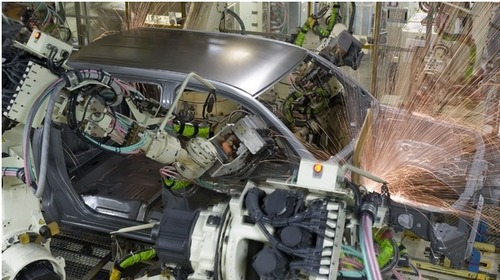
This article from Industry Week suggests that for Toyota to use high technology in Manufacturing is something new or a departure from its traditional system. It presents the Assembly Line Control (ALC) system as something new, when it has been in existence since at least the early 1990s.
We should not forget that even Ohno described jidoka as one of the two pillars of the Toyota Production System, on a par with Just-in-Time, and that jidoka means “automation with a human touch,” or “autonomation.”
The English-language literature often reduces jidoka to making machines stop when they malfunction, but the actual jidoka includes a complete automation strategy, with sequences of steps to automate both fabrication and assembly operations, as well as an approach to managing the interactions between humans and machines on a manufacturing shop floor.
From this article, it appears that the focus is on clerical support functions and loading docks, not on patient care. This is how it is described:
“Recently, the hospital used Lean thinking concepts to create more efficiency between its clinical and clerical staff by ensuring that the proper documentation forms are available for particular procedures.
‘We created a card that informs the clerical staff what form is needed and how many forms to print,” said Rommell. “We also did some reorganization in our loading dock area to create more efficiency in handling our supplies.’”
As is common in the press, the background on Lean is not entirely accurate. For example, the article says:
“… the Toyota Production System[…] spread to American manufacturers with publication of the book, ‘Lean Thinking'”
Actually, it started in the early 1980s, about 15 years before.
Further, it says:
“…hospitals across the nation have moved to incorporate the Japanese principles of ‘Six Sigma’ and ‘Lean’…”
Six Sigma came from Motorola, and there is nothing Japanese about it.
And next:
“Toyota […] has been using these principles for a long time…”



Nov 22 2012
The trouble with Lean | Canadian unionist blogger bashes Lean healthcare
See on Scoop.it – lean manufacturing
See on diablogue.org
Share this:
Like this:
By Michel Baudin • Blog clippings 0 • Tags: Canada, Health care, Lean, Union