Raku-Raku seat

How to eliminate “Muri,” or overburdening

“Muri, Muda, Mura” is often mentioned in the Japanese manufacturing literature as a trio of evils to avoid. Of the three, Muda gets the most attention. Usually translated as waste, it designates everything we do in a factory that is unnecessary.  For a change, let us focus on Muri.

Muri, in everyday Japanese, means impossible, with the nuance of unreasonable or unsustainable. A person working exceptionally hard is said to be doing Muri. Other words are used to say that something would violate the laws of physics, or that it is socially improper or inopportune. When there is Muri in your process, it means that you are asking people to work too hard, which results in  defects, burnout, repetitive stress injuries, or even accidents. Conversely, removing Muri means making your process humanly sustainable, so that is can be executed as well at the end of a shift as at the beginning, by a 50-year-old  or a 20-year-old, a man or a woman, 5 or 7 feet tall.

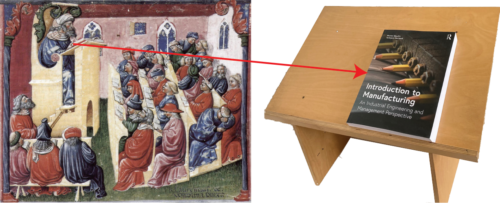
It cannot be repeated often enough that Lean is not about making people work harder but instead, in the tradition of Frank and Lillian Gilbreth, in making the work easier to do. When you observe a truly Lean plant, you do not see operators hurrying. Instead, you see them working steadily, at a sustainable pace, at jobs that are carefully choreographed for effectiveness and efficiency. A key example of Muri elimination is the raku-raku seat shown above. It is a device introduced at Toyota in the 1990s and now adopted by many car makers to remove the need for operators to crawl into car bodies in order perform assembly tasks inside.

There are many tools to remove Muri. You can easily notice that an operator is overburdened by direct observation in the shop. A more systematic approach is to use Toyota’s TVAL to rate jobs based on the weight operators have to carry and how long they have to carry it. TVAL establishes an equivalence between combinations, so that, for example, carrying 4 lbs for 200 seconds is equivalent in terms of fatigue impact to carrying 10 lbs for 4 seconds. You then focus on the jobs with highest TVAL ratings and improve these jobs to reduce it.

Once you know which job to focus on, you record it on video and review it with the operator to identify ways to make it easier or to offload parts of it to others with lighter burdens. If the job involves interactions between operators and machines, you analyze with with a work combination chart to improve task sequencing and identify tasks within the job that need better tooling or a better work station layout.

Chaku-Chaku lines covered in the Manila Times today — When in the US press?

Via Scoop.itCellular manufacturing

Chaku-chaku lines are the second generation of cells, allowing a single operator to run15 or even 20 machines. The key concept is for all the machines to have automatic unloading, so that the operator focuses on validating each step through go/no-go gauges and loading the workpiece into the next machine. It’s a concept that deserves more attention than it has received so far outside of Japan.
Via www.manilatimes.net

OLYMPUS DIGITAL CAMERA

Russian award for manufacturing excellence named after A. K. Gastev

In any country, if you can present Lean as the continuation of the work of local pioneers, it is easier to implement than as a wholly alien concept. Lean’s debt to Ford, Taylor, Gilbreth, the TWI program, and others is acknowledged in Japan, which makes the connection easy to make in the US. In Russia, it was more of a challenge.

At OrgProm in 2008, Mikel Wader first told me about Gastev, who was by then so obscure that his books had not been reprinted in 40 years and it took months for OrgProm’s Julia Klimova to locate copies for me. A quick look at Gastev’s works then convinced me that he was indeed someone Russians could look up to as a precursor to Lean. Alexey Kapitonovitch Gastev (1882-1939) was the father of industrial engineering in Russia, creator of the Central Institute of Labor in Moscow in 1920, author of How Work Must be Done (Как надо работать) and Worker Training (Трудовые установки).  Through an example,  Figure 1 illustrates his thinking. His career was cut short when the government shot him as a “counter-revolutionary” in 1939.

Figure 1. Gastev’s sketch of multiple phases of improvement on a tube piercing operation

In 2008, OrgProm was already making efforts to naturalize Lean for Russia, for example by using the graphic style of soviet-era posters in illustrations of 5S. In the same spirit, I thought that establishing a “Gastev Prize” for manufacturing excellence would also make sense and suggested it. OrgProm followed up, and I was pleased this morning to receive the following notice from Omsk University’s Konstantin Novikov:

PROJECT OF THE YEAR: CUP, AK Gastev.
Gasteva Cup – a public initiative, Interregional Public Movement “Lin-Forum. Professionals lean manufacturing. “It lies in the organization and conduct of national competition efficiency of production systems among the leading companies. Companies may be nominated for the award and the Cup as Gasteva program effectiveness and individual projects. Results evaluates expert group, consisting of the most respected and experienced expert consultants on operational efficiency and top managers of successful companies. The award ceremony will be held Gasteva Cup on November 15-18 at the VI Forum “Development of production systems” (up to 2011 – Russian Lin forum “Lean Russia”).
Shooting video from stepladder for blog

Sports video analysis software used for motion studies in manufacturing

From the press:

The adoption of video technology in the improvement of manufacturing operations proceeds at a glacial pace. A recent article from the Financial Times describes the application of video analysis developed for sports to motion studies in manufacturing.
Via Scoop.itlean manufacturing
Dave Westphal’s 13-year-old daughter, Rachel, is a competitive figure skater. She is also the inspiration for a manufacturing improvement initiative at Nexteer Automotive, a leading US-based maker of steering and driveline systems for the car industry, where her father is director of lean manufacturing.
Via www.ft.com (You have to register on the Financial Times site to retrieve it, but a free registration will do.)

My comments:

Video technology is now so pervasive that it is nearly impossible to buy a phone that does not include a camera capable or recording footage that is good enough for broadcast news. Journalists use amateur videos to show storm damage or expose human brutality. We use it to identify improvement opportunities in business operations.

Motion pictures have a long history in manufacturing:

As is obvious from watching the Gilbreth films, where Taylor measured in order to control, the Gilbreths observed in order to improve. Taylor’s greater fame or notoriety, however, obscured this fundamental difference in the public mind, and made workers as wary of cameras as of stopwatches.

According to psychologist Arlie Belliveau,”The Gilbreths used workers’ interest in film to their advantage, and encouraged employees to participate in the production and study of work through film. Participants could learn to use the equipment, star in a film, and evaluate any resulting changes to work practices by viewing the projected films in the labs or at foremen’s meetings. Time measurements were made public, and decisions regarding best methods were negotiated. By engaging the workers as participants, the Gilbreths overcame some of the doubt that followed Taylor’s time studies.” In other words, these pioneers already understood that, unlike the stopwatch, this technology enabled the operators to participate in the analysis and improvement of their own operations.

Until recently, however, the process of recording motion was too cumbersome and expensive, and required too much skill, to be massively practiced either in manufacturing or in other types of business operations. In addition, most managements failed to use it in as enlightened a way as the Gilbreths, and manufacturing workers had a frequently well-founded fear that recordings would be used against them. As a consequence, they were less than enthusiastic in their support of such efforts.
Setup time reduction is probably the first type of project in which it was systematically used, first because the high stakes justified the cost, even in the 1950s and second because its objective was clearly to make drastic changes in activities that were not production and not to nibble a few seconds out of a repetitive task by pressuring a worker to move faster.

Technically, the cost of shooting videos has not been an issue since the advent of the VCR in the 1980s. Analyzing a video by moving forward and backwards on a cassette tape, while it appears cumbersome today, was far easier than dealing with film. The collection of data on electronic spreadsheets also eliminated the need to use counterintuitive time units like “decimal minutes.” Adding columns of times in hours, minutes and seconds was impractical manually but not a problem for the electronic spreadsheet.

With videos now recorded on and played back from flash memory, and free media-players as software, not only is moving back and forth in a video recording is easier, but the software maps video frames to the time elapsed since the beginning. We could manually transfer timestamps read from the bottom of the video player software window into electronic spreadsheets and have the spreadsheet software automatically calculate task times as the differences between consecutive timestamps.

While this approach has been a common practice for the past 15 years, video annotation software is available today, which helps break down the video into segments for steps, label them, categorize them, and analyze them.
You can also use it to structure the data and generate a variety of analytics to drive improvements or document the improved process through, for example, work instructions. Over the previous approach, video annotation has the following advantages:

  1. It automates the collection of timestamps. Reading times on the video screen and typing hem into an Excel spreadsheet is tedious and error-prone. Plowing through the details of a 30-minute is tedious enough already.
  2. Within the annotation software, each video segment remains attached to the text, numeric or categorical data you attach to it. One click on the data brings up the matching video segment.
  3. Using parallel tracks, you can simultaneously record what several people and machines do. Of course, you can do that without annotation software too, but it is more difficult.
  4. You can still export the data you collect and analyze it in Excel, but you can also take advantage of the software’s built-in analytics.

“Video time studies” is too restrictive a name for what we do with videos. It implies that they are just a replacement for a stopwatch in setting time standards. But what we really do with videos is analyze processes for the purpose of improving them, and this involves more than just capturing times. The primary pupose of the measurements is to quantify the improvement potential to justify changes, and to validate that they have actually occurred.

Putting this technology to use is not without challenges. Video files are larger than just about any other type we may use, be they rich text, databases, or photographs. And they come in a variety of formats and compression methods that make the old VHS versus Betamax dilemma of the VCR age look simple. More standardization would help, and will eventually come but, in the meantime, we have to learn more than we want to know about these issues. Functionally, the next technical challenge is the organization of libraries or databases for storage and retrieval of data captured in the form of videos. The human issues of video recording and analysis of business operations, on the other hand, remain as thorny as ever.

Software development Kanban

From scancards to “personal kanbans” and Ybry charts

Professionals know that their productivity drops when they take on too many concurrent projects. An engineer whose attention is split across 15 projects doesn’t contribute effectively to any. But it happens because supervisors keep piling on assignments without regard to this phenomenon. Over the years, cures have been proposed under different names, all aiming to cap work in process.

About 1982, a colleague showed me the system he used to manage what he was working on. It was called the Scancard System, and it used the hardware  in Figure 1. The cards were square, with 3 1/4-in sides and borders of different colors. They came with letter-size card pocket plastic boards that you could insert into 3-ring binders, keep on your desk or pin to a wall.

Figure 1. The Scancard System

He used it with one column for his backlog of things to do, one column for work in process, and one column for completed items. It was a paper-based system but, at the time, so was almost everything we did. It gave you visibility, it capped the number of items you were working on at one time, and moving cards from one column to the next was an effective metaphor for the flow of your work. The ads showed smartly dressed managers using their scancard systems in meetings. I went for it and used it for years, until I had a project with a company that used another system and switched to fit in.

Fast forward to 2011. Scancard Systems is out of business, and I hear of a system called “Personal Kanban,” that is focused on providing visibility and limiting work in process, using a white board and Post-Its as in Figure 2:

Figure 2. “Personal Kanban”

I put quotes around the name because I find it to be little more than a feat of vocabulary engineering, leveraging the buzz around a feature of Toyota’s production control system to repackage ideas that have little to do with it, are very simple and have been around for a long time. A software developer visiting a factory may see a similarity with Toyota’s Kanbans, but it escapes me.

Of course, if, as in Figure 2,  it is on a white board, you can’t carry it with you to a meeting or share it in your network. The Personal Kanban website advertizes an iPhone app called iKan, that I can’t find on Apple’s App Store. On the other hand, Leankit Kanban offers a web-based application with an iPhone version that looks very much like a team to-d0 list management system. It looks most useful if your work can be perceived as a collection of independent activities, which happens if each Post-It is for a whole project or for a prospect in a sales cycle. But it would not fit if each Post-It were for a task within a project, with precedence constraints or iterations between tasks.

Another limitation of such a status board is that is only shows current status, as compared, for example, with the Ybry chart of Figure 3, which shows the complete history of each project by using a line for each project rather than a card. Like the status board, it assumes that all project go through the same sequence of phases.

Figure 3. Ybry chart for projects going through the same sequence of phases

Ybry charts were invented by Charles Ybry in 1846 for railroad scheduling, and are still used for that purpose. See Edward Tufte’s Envisioning Information, pp. 107-110. The work-combination charts used in Lean operator job design are a variation on this method, as explained in Working with Machines, pp. 133-154.

River Rouge Coke Ovens 1946-1976

Factory life with and without Kaizen

In Kaizen, Masaaki Imai describes Japanese executives returning in the 1970s to American plants they had visited thirty years before and being struck by the absence of change: they saw the same production lines with the same equipment operated the same way. This started me looking for photographic evidence. Overall, pickings were slim, but I did find the above pictures of the same coke oven at the Ford River Rouge plant shot in 1946 and 1976.

If there is Kaizen activity in a factory, how does it change the work life of employees at all levels? The following chart compares the breakdowns of their use of time, with and without Kaizen:


In a plant without Kaizen, operators and supervisors are fully occupied with routine daily tasks: production for the operators, expediting parts, enforcing discipline, and record keeping for supervisors. Only middle managers and executives spend a fraction of their time on projects involving capacity changes, new production lines or new technology. Nobody works on incremental improvements to the way the work is done today.

By contrast, Kaizen involves employees at all levels  in such improvement activities to different degrees. Between improvement and daily routine, the boundary is sharp;  between improvement and innovation, fuzzy. Over time, the cumulative effect of incremental improvement is radical change by itself. In addition, the skills acquired and the lessons learned from incremental improvements are incorporated into new line or plant design projects. In some Japanese auto parts plants, I remember seeing automatic lines side-by-side, where one used old machines that had been gradually retrofitted with devices that reduced the need for human intervention, while the other one had been built from scratch with new machines to be automatic. The Kaizen work done to implement the former was essential to the success of the latter.

yardstick

The staying power of bad metrics

A speaker I once heard on manufacturing metrics started with a quote from football coach Vince Lombardi: “If you’re not keeping score, you’re only practicing.” In a sport, your score or your rank is, by definition, the correct measure of success, and we assume too easily that this kind of thinking crosses over to every human endeavor, from national economies to plant performance or education. In this process, we begin using highly aggregated metrics as if they were physical measurements like mass or speed, and avert our eyes from how these sausages are made.

Following are a few of the egregious examples:

  • GDP. Gross Domestic Product (GDP), for example, is in the news everyday. If you pollute and spend money to clean up your toxic waste, you contribute more to the GDP than if you produce cleanly. Because of this kind of absurdity, GDP as a metric has been criticized by many economists, including Joseph Stiglitz. In 2009, he even convinced French president Nicolas Sarkozy to seek alternatives. Yet, two years later, the same president is pushing to include in the country’s constitution a “Golden Rule” that caps budget deficits at a percentage of the same flawed GDP!
  • IQ. In the US, IQ  is still widely treated as a measure of intelligence. On its face, the notion that human intelligence is reducible to a number is an insult to its subject. In fact, all an IQ measures is the ability to take an IQ test. Psychologists recognize this, but many school teachers and the public at large don’t. (See Steven Jay Gould’s The Mismeasure of Man.)
  • Food calories. Calories are the most commonly used metric in nutrition. What this number actually represents is the heat generated by drying and burning a food item. But is digestion the same as combustion? Obviously not, for example, for fibers, which cross the human body unchanged. The absurdity of assigning calories to fibers has not escaped one dieter, who questioned it on a Calorie Count forum, and received, among other replies, the following:

Fiber calories are included in nutrition information, but only in come countries. In the US, it is legal to not put in fiber calories because they are not digestible. Therefore, they do not “count” as such. however, if you, like most people, tend to underestimate cals sightly, there is nothing wring with including them to create a “buffer zone.”

In other words, it makes no sense but you should pretend it does.

Do we behave the same way in the manufacturing world? Yes. For example, many companies measure productivity in terms of Sales/Employee. There is an easy way to boost this metric: outsource all production, close all plants and become a trading company. It is not easy to find metrics for quality, cost, delivery, safety and morale that are meaningful and cannot be gamed, but it can be done. For overall company productivity, for example, you can use Value added/Employee, where

Value added = Sales – (Materials + Energy + Outsourced Services)

This is what Peter Drucker called Contributed Value. Value added/Employee is not a perfect metric, but at least it does not provide a perverse incentive to outsource, and the US census bureau publishes statistics on value added and employment by industry, that are helpful for benchmarking.

Following are a few conditions that a good metric must meet:

  1. A good metric is immediately understandable. No training or even explanation is required to figure out what it means, and the number directly maps to reality, free of any manipulation. One type of common manipulation is to assume that one particular ratio cannot possibly be over 85%, and redefine 85% for this ratio as “100% performance.” While this makes performance look better, it also makes the number misleading and difficult to interpret.
  2. People see how they can affect the outcome. With a good metric, it is also easy to understand what kind of actions can affect the value of the measurement. A shop floor metric, for example, should not a be function of the price of oil in the world market, because there is nothing the operators can do to affect it. Their actions, on the other hand, can affect the number of labor-hours required per unit, or the rework rate.
  3. A better value for the metric always means better business performance for the company. One of the most difficult characteristics to guarantee is that a better value of a metric always translates to better business performance for the company. Equipment efficiency measures are notorious for failing in this area, because maximizing them often leads to overproduction and WIP accumulation.
  4. The input data of the metric should be easy to collect. Lead time statistics, for example, require entry and exit timestamps by unit of production. The difference between these times then only gives you the lead time is calendar time, not in work time. The get lead times in work time, you then have to match the timestamps against the plant’s work calendar. Lead time information, however, can be inferred from WIP and WIP age data, which can be collected by direct observation of WIP on the shop floor. Metrics of
    WIP, therefore, contain essentially the same information but are easier to  calculate. (See Little’s Law.)
  5. All metrics should have the appropriate sensitivity. If daily fluctuations are not what is of interest, then they need to be filtered out. A common method for doing this is to plot 5-day moving averages instead of individual values — that is, the point plotted today is the average of the values observed in the last five days. Daily fluctuations are smoothed away, but weekly trends stand out.

Peter Drucker sold corporate America on the idea that you can’t manage what you can’t measure, and this has led many managers to believe that employees would do whatever it takes to maximize their scores. Given  flawed metrics, it if fortunate for the companies that these managers were wrong. If they had been right, all the  companies that measure productivity in terms of  Sales/Employee would actually have outsourced all production. They didn’t, because metrics are only one of many factors influencing behavior. Most employees, at all level, will not maximize their metrics through actions they feel violate common sense or are inconsistent with their personal ethics.

Taxis waiting for people and people waiting for taxis - reduced

Waiting for each other

We have all seen the absurd situation in the featured picture above of a line of customers waiting for taxis while a line of taxis next to them is waiting for customers, with a barrier separating them. This particular instance is from The Hopeful Traveler blog. The cabs are from London, but the same scene could have been shot in many other major world cities.

I am sure we have all encountered similar situations in other circumstances, which may or may not be easy to resolve. One particular case where it should be easy is the restaurant buffet. Figure 1 shows a typical scene in buffet restaurants, with a line of people waiting to get food all on the one side of the table, while food is waiting and accessible on the opposite side.

Figure 1. A typical buffet

I think the fundamental mistake is the assumption that a buffet is like an assembly line, providing sequential access to dishes. This means that you cannot get to the Alo Gobi until the person in front of you is done with the Tandoori.  The ideal buffet would instead provide random access, meaning that each customer would have immediate access to all dishes at all times. While it may not be feasible, you can get much closer to it than with the linear buffet. The following picture shows an alternative organization of a buffet in circular islands that is non-sequential.

Figure 2. A buffet island at the Holiday Inn in Visalia, CA

The limitation of this concept is that replenishment by waiters can interfere with customers. To avoid this, you would want dishes to be replenished from inside the circle while customers help themselves on the outside, as in the following sketch:

Figure 3. A buffet island with replenishment from inside

One problem with the circular buffet island, however, is its lack of modularity. You can add or remove whole  islands but you cannot expand or shrink an island, which you can if you use straight tables arranged in a U-shape, as in Figure 4.

Figure 4. Buffet island with straight tables

This buffet island may superficially look like a manufacturing cell, but it is radically different. Its purpose is random access to food as opposed to sequential processing of work pieces, and the materials do not flow around the cell but from the inside out.

Such are the thoughts going through my mind while munching on the Naan at Darbar.

Steam locomotive and typewriter

The steam locomotive and the typewriter

The first draft of my book  Working with Machines contained a chapter that was a post-mortem on two obsolete machines, which was cut on the grounds that, unlike all other chapters, it was not actionable for the reader.

Its abstract is as follows:

The steam locomotive and the typewriter are icons of the industrial age, and their parallel histories show different aspects of the human experience of working with machines. The steam locomotive is fondly remembered; the typewriter, all but forgotten except for the QWERTY keyboard. The steam engine participated in the development of every industrial economy, but the typewriter played no major role in Japan. The typewriter did not demonstrably improve the productivity or quality of office output, but was adopted only because of its image of modernity.

Locomotive driver was a prestigious position for a manual laborer, but typist never was. Compared to electrics and diesels, the steam locomotive had a cab that was exposed to the elements and to the heat of the firebox and therefore uncomfortable, difficult to operate, and dangerous. Yet engineers and firemen preferred it to the tedium and loneliness of modern locomotives. Automatic machines that require human attention only when they malfunction are also in airplanes and in manufacturing plants, challenging the job designer to keep the operator alert and used efficiently.

As the typewriter prints one keystroke at a time, typists were always busy with a single machine and determined both its productivity and output quality. Typists worked in comfortable places, but under pressure, and faced the long-term hazards of sedentary work. The typewriter’s main legacy is that a society can make a long-term investment in machines whose tangible benefits do not obviously exceed their costs.

Click here for a pdf file of the entire chapter.