Oct 25 2011
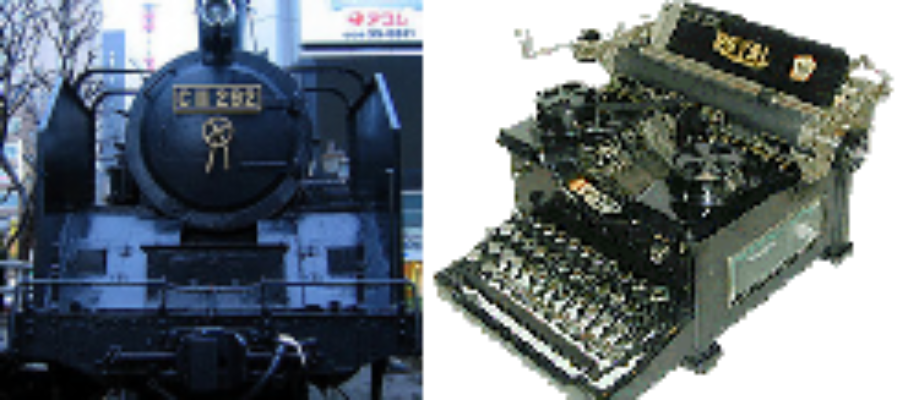
The steam locomotive and the typewriter
The first draft of my book Working with Machines contained a chapter that was a post-mortem on two obsolete machines, which was cut on the grounds that, unlike all other chapters, it was not actionable for the reader.
Its abstract is as follows:
The steam locomotive and the typewriter are icons of the industrial age, and their parallel histories show different aspects of the human experience of working with machines. The steam locomotive is fondly remembered; the typewriter, all but forgotten except for the QWERTY keyboard. The steam engine participated in the development of every industrial economy, but the typewriter played no major role in Japan. The typewriter did not demonstrably improve the productivity or quality of office output, but was adopted only because of its image of modernity.
Locomotive driver was a prestigious position for a manual laborer, but typist never was. Compared to electrics and diesels, the steam locomotive had a cab that was exposed to the elements and to the heat of the firebox and therefore uncomfortable, difficult to operate, and dangerous. Yet engineers and firemen preferred it to the tedium and loneliness of modern locomotives. Automatic machines that require human attention only when they malfunction are also in airplanes and in manufacturing plants, challenging the job designer to keep the operator alert and used efficiently.
As the typewriter prints one keystroke at a time, typists were always busy with a single machine and determined both its productivity and output quality. Typists worked in comfortable places, but under pressure, and faced the long-term hazards of sedentary work. The typewriter’s main legacy is that a society can make a long-term investment in machines whose tangible benefits do not obviously exceed their costs.
Click here for a pdf file of the entire chapter.

Oct 27 2011
Waiting for each other
We have all seen the absurd situation in the featured picture above of a line of customers waiting for taxis while a line of taxis next to them is waiting for customers, with a barrier separating them. This particular instance is from The Hopeful Traveler blog. The cabs are from London, but the same scene could have been shot in many other major world cities.
I am sure we have all encountered similar situations in other circumstances, which may or may not be easy to resolve. One particular case where it should be easy is the restaurant buffet. Figure 1 shows a typical scene in buffet restaurants, with a line of people waiting to get food all on the one side of the table, while food is waiting and accessible on the opposite side.
Figure 1. A typical buffet
I think the fundamental mistake is the assumption that a buffet is like an assembly line, providing sequential access to dishes. This means that you cannot get to the Alo Gobi until the person in front of you is done with the Tandoori. The ideal buffet would instead provide random access, meaning that each customer would have immediate access to all dishes at all times. While it may not be feasible, you can get much closer to it than with the linear buffet. The following picture shows an alternative organization of a buffet in circular islands that is non-sequential.
Figure 2. A buffet island at the Holiday Inn in Visalia, CA
The limitation of this concept is that replenishment by waiters can interfere with customers. To avoid this, you would want dishes to be replenished from inside the circle while customers help themselves on the outside, as in the following sketch:
Figure 3. A buffet island with replenishment from inside
One problem with the circular buffet island, however, is its lack of modularity. You can add or remove whole islands but you cannot expand or shrink an island, which you can if you use straight tables arranged in a U-shape, as in Figure 4.
This buffet island may superficially look like a manufacturing cell, but it is radically different. Its purpose is random access to food as opposed to sequential processing of work pieces, and the materials do not flow around the cell but from the inside out.
Such are the thoughts going through my mind while munching on the Naan at Darbar.
Share this:
Like this:
By Michel Baudin • Technology 3 • Tags: Buffet, industrial engineering, Lean manufacturing, Restaurant