Dec 22 2025
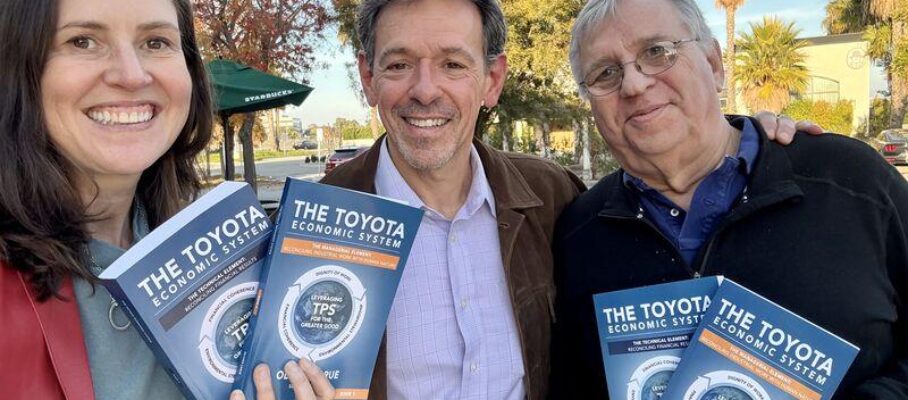
Three San Francisco Bay Area Writers Have Coffee
When Katie Anderson, Olivier Larue and I met last Thursday, what did we discuss? We started with the pros and cons of self-publishing versus going through established publishing houses. Then we talked about the challenges and opportunities of providing books in various media. We discussed Olivier’s two new books and, finally, our kids. Katie has the youngest ones; I have the oldest.
Self-publishing Versus Publishing Houses
After considering offers from publishing houses, Katie opted to self-publish her first book, Learning to LEAD, leading to LEARN, under her own imprint. It has sold well over the past five years. Katie reflected that creating a successful book requires effort in both writing a quality book and relentless promotion and marketing to reach audiences who might not know about it.
Olivier published the first edition of Book 1 of The Toyota Economic System through a publisher but switched to self-publishing for the second edition, as well as for Books 2 and 3, on The Technical Element and The Managerial Element.
My first book, Manufacturing Systems Analysis, was through Prentice Hall. the next three, Lean Assembly, Lean Logistics, and Working with Machines, were the nuts-and-bolts series at Productivity Press. The fifth, Introduction to Manufacturing, co-authored by Torbjørn Netland, was published by Routledge. Both Productivity Press and Routledge are part of Taylor & Francis, so, formally, it’s the same publisher. I am, however, self-publishing my next book, about quality management and technology..
Over 40 years, I have seen publishers’ services to authors wither away as self-publishing technology improved and became cheaper. In 1989, Prentice Hall invited other authors and me to a half-day seminar at the Plaza Hotel in New York, but those days are gone.
Advances have shrunk and book editors have vanished. Productivity Press used to assign a book editor to each of my projects, who gave me valuable advice on book content and structure. They also sent chapters to reviewers. They no longer do any of this, and, once a book is out, it’s just one entry in the publisher’s catalog.
Pbooks, Ebooks, and Audiobooks
We also discussed the pros and cons, and effort required, to create multiple formats — print, ebook, and audiobook. Katie recorded the audiobook in her own voice. Ebooks are searchable, which is a key advantage in nonfiction. Even a reader who prefers print can use the ebook to find all the occurrences of, say, “heijunka” in the book, and then read what it says on paper.
Olivier’s Two New Books
Then we zoomed in on Olivier’s two new books on the Toyota Economic System, The Technical Element and The Managerial Element. Olivier gave us both copies of these books at the meeting, and I haven’t read them yet, but the subtitle of the latter caught my attention: “Reconciling industrial work with human nature.”
What I do know is that these books distill Olivier’s personal experience working for Toyota in the US, ranging from assembling cars at NUMMI to helping suppliers learn the system at the Toyota Supplier Support Center (TSSC).
Teaching Styles
Olivier describes this learning experience as intense and based on “tough love”: the more his mentors at Toyota believed in him, the harsher they criticized his work, saving kind words and a friendly demeanor for people they considered hopeless. I have experienced the same in Japan, outside the Toyota context, and it is common in the US in sports coaching. Damien Chazelle’s first movie, Whiplash, was a meditation on this type of master/apprentice relationship in music. I do not believe in this approach and have never practiced it.
Personal Stuff
Finally, we exchanged on our personal lives, sharing our children’s achievements, and touching on our future plans.
#lean, #manufacturing, #publishing, #toyota
December 22, 2025 @ 4:45 pm
Michel, your notes about the services from the publisher very much mimic my experience with “Becoming the Supervisor”, published through Productivity Press / Routledge / Taylor & Francis. Virtually no useful support, and five years on, I am just a line in their catalogue. Katie is inspirational in what she has accomplished with her relentless promotion of her book.
December 22, 2025 @ 4:46 pm
Michel: Your website does not allow for websites with the .ca domain.
My website is http://www.firstlinetraining.ca.
February 14, 2026 @ 3:29 am
It’s interesting to see how self-publishing shifts the responsibility for quality control and promotion entirely onto the author. From a financial perspective, keeping detailed records of expenses for editing, formatting, and marketing is crucial, especially if you’re tracking royalties or claiming deductions for tax purposes. I’ve found that treating each edition—print, ebook, audiobook—as a separate revenue stream with its own cost tracking makes both accounting and strategic planning much clearer.