Via Scoop.it – lean manufacturing
Heard on NPR this afternoon. Lean was not mentioned, but, if Aravind has found ways to perform cataract operations faster, better, and cheaper, it probably deserves to be called a Lean organization.
Via www.npr.org
Monthly Archives: November 2011
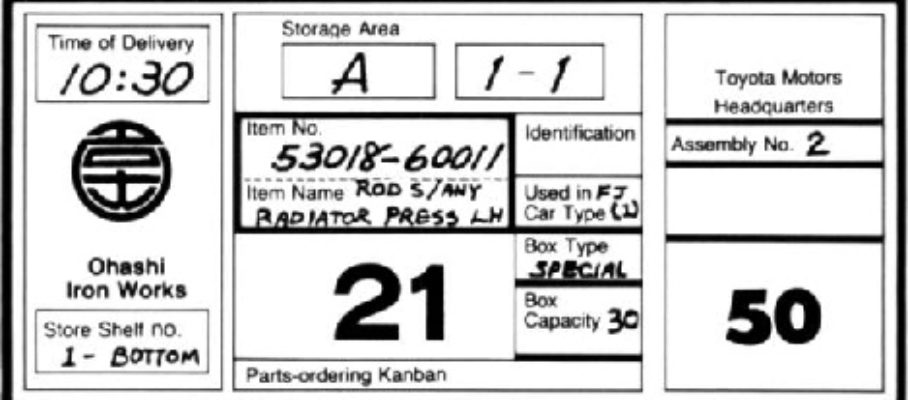
More about Kanbans, and What it Takes to Use Them.
Ever since the world outside of Toyota started noticing its production system in the late 1970s, the Kanban system has received a disproportionate amount of attention compared to other features. It does not mean, however, that it has been accurately implemented in many of the factories that claim to have done it. To anyone who cared to study it, details have been available in English at least since Robert Hall’s Zero Inventories (1983), the JMA’s Kanban, Just-In-Time at Toyota (1985), Yasuhiro Monden’s Toyota Production System (1993), or an updated treatment in Lean Logistics (2005).
Pressured to implement Kanbans by executives to whom it was little more than a buzzword, many manufacturing professionals found it more expedient to take old, familiar approaches like the two-bin system or reorder-point and call them Kanban. One such system implementing reorder-point through cards placed on a board has become so popular in France that I suggested calling it “French Kanban.” As can be seen in Figure 1, each column on the board is a mirror of the inventory level for an item. Each pocket filled by a card corresponds to an empty slot in stores, so that the remaining amount is visually indicated by the empty pockets on top. The reorder point is crossed when the cards reach the red zone.
Figure 1. French Kanban: Reorder-Point with Cards
Meanwhile, a few academics like J.T. Black at Auburn University or Robert Hall at Indiana University took the trouble to thoroughly investigate the Toyota system as a whole and the Kanban system in particular, but most of their colleagues didn’t, preferring a simplistic rendition of the Kanban system that made their own ideas stand out by contrast. In this context, insisting on the genuine Kanban system is perceived as nitpicking, because the differences are not in the big idea but in the details. You can easily dismiss these details as insignificant until you consider their cumulative effect on thousands of shop floor transactions every day.
Here are two examples, found today in a blog post:
- A common misconception is that you pull a Kanban from a bin when it is empty. If this were true, you would just be using a card to implement the Two-Bin system. The Kanban is not pulled when the bin is empty but when you withdraw the first part from the bin, to allow the bin to cover consumption during the replenishment lead time.
- Another in the same post was that the eKanban system did not involve physical cards. It is conceivable that, in the future, goods in transit will only be identified by RFID tags, but it is not the state of the art. They still need some form of human-readable identification and routing, for which a purely electronic system would require some kind of screen on each container. In fact, the electronic signal is used only in the return part of the loop, to eliminate the labor-intensive, slow and error-prone handling of unattached cards. On the supplier side, you print single-use cards that are attached to bins for transfer to the customer. When you detach the car on the customer side, you scan its barcode, and this triggers the electronic replenishment signal.
When evaluating or learning a tool like the Kanban system, you have to consider the following:
- The objects. They may be cards carrying specific data, bins of particular sizes and configurations, electronic messages of a given structure, … This is what we have to play with. Their physical nature makes a difference, not in a philosophical way but in basic, practical ways. For example, cards can be shuffled and posted on boards but bins cannot. When you send a card, you no longer have it, but when you send an electronic message, you still do. With the former, you have to make sure it doesn’t lose its way; with the latter, that it isn’t accidentally sent multiple times.
- The rules. These are protocols for users to follow. They specify who is allowed or required to do what to which objects when. In the Kanban system, the rules say who can issue new Kanbans or remove them from circulation, who attaches Kanbans to bins and detaches them, and what events trigger these actions. The rules give the objects meaning, as the rules of poker do to a deck of cards.
- The mapping to reality. This is what happens to materials and goods in production and logistics when people follow the rules. When applied rigorously in the right context, the Kanban system tells production operators and materials handlers exactly what they should work on. Unlike the traditional dispatch lists, instructions in the form of Kanbans leave no ambiguity and require no judgement call by the leader or supervisor.
Within its range of applicability, the Kanban system is both simple enough for people to apply and sophisticated enough to get the job done. This is a tall order, and we should not underestimate what it takes.
Even in Japanese, the word Kanban has many different meanings, the most common being a sign advertising a store on the street, as you can see by searching Google images for “看板” (Kanban). Figure 2 shows, on a sidewalk, the Kanban of a beauty salon located on the 2nd floor of the building.
Assembly Mag’s John Sprovieri responds to Kevin Meyer about Lean at Whirlpool
Via Scoop.it – lean manufacturing
John Sprovieri’s article opens with the following :
“Austin Weber’s article on lean manufacturing at Whirlpool was part of a series of articles written to celebrate the 100th anniversary of the company. As such, it was not the appropriate venue to dwell on the negative aspects of the company’s history, but rather to celebrate the accomplishments of one of this country’s great manufacturers.”
I could see “celebrating accomplishments” as a role for the company’s Public Relations department in an ad page. But is a reporter supposed to be a cheer leader for the companies he covers?
Via www.assemblymag.com
And the Winners of the Gastev Cup for 2011 are…
This is a translation of the announcement in the Russian Business Excellence magazine. You can also watch the award ceremony on Youtube, in Russian without subtitles, from honorable mentions to the cup itself.
The Gastev Cup for business effectiveness
The overall winner and winners in individual categories of the Gastev Cup, Russia’s first competition in business effectiveness, were announced during the Moscow VI Forum on Development of Production Systems, formerly known as Lean Forum. The ceremony capped a long enough period of checking the conformity of the production systems of the candidate companies to the contest requirements. For several months the team of independent auditors visited the candidates, from St. Petersburg to Novosibirsk.
And the winners are:
- Cup winner - the TMS-group from Almetyevsk.
- Leader in human resource development – the Grand Gift company from Moscow.
- Leader in process development – the Russian Coatings company from Yaroslavl.
- Winner in the Production System Industry category – OAO “RZD”.
- Winner in Lean regional government category – the Republic of Tatarstan.
Honorable mentions were also also awarded to Packer, from the October region, Saturn -Gas Turbines from Rybinsk, Spartacus from Kazan, and Elsib from Novosibirsk.
Expert opinion from Konstantin Novikov
Konstantin Novikov is general director if Stal steel works in Omsk, and member of the Council of Lean Production Professionals.
Our congratulations to the winners and runners-up of the first Gastev Cup Gasteva. The second cup is exactly one year away. In 2012, if the TMS-group wants to keep the cup, they will have to fight for it again, developing their people and their production processes, and demonstrating a commitment to continuous improvement.
Grad student puts homework on ERP and Lean up for bids
Via Scoop.it – lean manufacturing
This student, who is “out of time and juggling many other tasks” is asking freelancers to bid on writing an essay on ERP and Lean Manufacturing for him. He has so far seven bidders offering to do it for an average of $78.
Via www.freelancer.com
A German prize for Lean in Automotive
The German Automotive Lean Production Awards 2011 were given at BMW World in Munich on 11/23, to Volkswagen in Bratislava , TRW in Koblenz, BMW in Leipzig and Landshut, Continental in Regensburg, and Behr in Mühlacker.
These awards have been given since 2005, based on studies conducted jointly by the German Automobil Produktion magazine and Agamus Consult. These studies are focused on the following questions:
- What are the success factors of Lean Production?
- Effectiveness and efficiency: how does the Lean methodology work?
- Goal of the Lean processes: What are the most important steps?
- Who uses Lean methods and strategies, and with what results in quality and costs?
- Thinking further: Lean Production as an integral part of the Lean Enterprise.
- How does Lean Production develop in Germany and Europe, and who is best in class?
Compared ot the Shingo Prize, the study questionnaire is more focused on tools and performance, and the first few questions are aimed at establishing that the candidate is in the automotive industry. The questionnaires are addressed to the managers responsible for Lean in production, logistics and development, as well as operations managers. A delegation of experts then visits the candidates selected based on the questionnaires. The involvement of one particular consulting firm in the organization of the award process would in the US be viewed as a conflict of interest. The Shingo Prize is run out of Utah State University, and uses consultants from multiple firms in its audit teams.
The process by which these awards are given otherwise raises the same questions as for the Shingo Prize: how good are they as predictors of superior long-term performance ?
Singaporean academics learn TPS at Toyota in Japan
Via Scoop.it – lean manufacturing
This is first-person account by a Singaporean acadenic of a two-day course culminating in a tour of the Tahara assembly line.
Via blog.nus.edu.sg
Sushi versus Raw Fish: Use foreign words only when you can’t help it
Via Scoop.it – lean manufacturing
James Hereford, COO of the Palo Alto Medical Foundation, prefers to use the original Japanese terms when deploying Lean, arguing that it doesn’t really matter whether words are Japanese or English, and that many Lean terms have no exact translation. While it is true for Kaizen or Kanban, it is not for Gemba, which he gives as an example. Gemba just means “actual place,” nothing more. As a general term, in English, it is not very telling but, in context, it can be replaced with shop floor, lab, operating room, race track, or back office, and there are more urgent things to do to implement Lean than burdening your audience with new, unnecessary words. My main concern in the field is to communicate as effectively and as precisely as possible, and I have found it easier with words my audience already knows, used literally when possible, and metaphorically when not.
People choose words for all sorts of reasons that have nothing to do with conveying a meaning, such as the following:
- Avoiding the emotional or historical baggage of a familiar word. Recycling the vocabulary of a past, failed program makes the new one less likely to succeed.
- Establishing their credentials as members of a group. Using the right jargon is more “professional” than using plain, everyday words. The audience then understands much better the speaker’s position than the meaning of the words.
- Leveraging ambiguity. New words are more likely to be taken to mean different things to different people, making the appearance of agreement easier to establish. This is a common practice of sales people.
Foreign words can serve all of these purposes, which I don’t pursue.
I still think foreign words are OK when:
- They have no local equivalent
- They are short.
- They are easy to pronounce.
Takt is German for musical bar or stroke, as in a four-stroke engine, and I have never seen a reasonable English equivalent to it in takt time. On the other hand, Kevin Hop and I struggled with the Japanese zentenatamadashi, which even Google knows nothing about. Literally, it means “all items sticking out their heads,” and Honda engineer Ray Sanders translated it as “Single-Piece Presentation.” We adopted it because it is accurate, descriptive, easy to remember, and no longer than the original.
San Antonio’s Nugget Co. goes Lean to reduce water consumption (???)
Via Scoop.it – lean manufacturing
“…Over the next two years, the center will work with The Nugget Co. to improve its wastewater treatment processes and to reduce the amount of water the manufacturer uses to produce its sheep and lambskin products…” (http://t.co/RcyYivMr) This is a novel application of Lean. I understand why overuse of water may be a problem for the company, but not what part of Lean might conceivably solve it. Assuming that water plays a part in the chemistry of leather making, the amount consumed is a matter of process engineering, and it is difficult to imagine anyone other than experienced process engineers finding how to reduce it without hurting quality. Lean projects typically improve the way an organization executes its processes, but not the processes themselves. They affect line and workstation design, operating policies, production control methods, and support activities, but usually not the phyics or chemistry of the processes.
Via story.manufacturingmirror.com
Key details on Poka-Yoke/Mistake-Proofing
The following are my inputs to a discussion on AME’s LinkedIn group initiated last August by Xola Qhogwana, which also included contributions from Steve Bathe, Richard Foster, Karen Wilhelm, Steven Wade, Wesley Bushby, Ron Turkett, and Trevor Krawchyk.
When to use Poka-Yoke
Poka-Yokes prevent human error, and are therefore relevant when and only when human error is the main cause of your quality problems.
If you have process capability issues, focus on resolving them, not on preventing human error. What you need is deep understanding of your technology combined with statistical tools to enable your process to consistently hold tolerances.
If your process is capable but you are still producing in batches, focus on converting to flow to prevent your defectives being buried in WIP. Your problem is that it takes you too long to detect problems, not human error.
If your process is capable and you practice one-piece flow, then the defects you still produce are due to human error. At this point, and not before, Poka-Yoke is the relevant technique.
For details, see When to use statistics, one-piece flow, or mistake-proofing to improve quality.
Poka-Yokes do not require extensive a-priori analysis
Poka-Yokes are usually small devices, such as a permanent magnet to suck up a panel already containing a metal bracket, or a hole in a container to prevent overfill.
Doing an FMEA do decide whether to design and implement a Poka-Yoke is more expensive than just doing it. If you sort of think a process might need a Poka-Yoke and you have an idea of what it might be, just go ahead, try it, and document it in your company-specific Poka-Yoke library to inspire others. Don’t over-analyze it upfront. On the other hand, if you are building a spacecraft, you should definitely do an FMEA.
If it adds labor, it’s not a Poka-Yoke
By definition, also a Poka-Yoke device adds no labor. Manually scanned barcodes on parts to validate picks, for example, do not qualify as a Poka-Yokes because they add labor. A barcode that is automatically read or an RFID tag , on the other hand, would qualify. A Poka-Yoke has to become part of the process in the long run. If you look at the old big red book of Poka-Yoke from Productivity Press, you will notice that none of the examples adds labor, and there is a reason: any device that adds labor is likely to be bypassed under pressure.
This even happens with safety. Take, for example, the traditional approach of requiring the pressing of two buttons to start a press. How many times to you see plants where one button is taped down so that you can start the press with just the other one? By contrast, safety light curtains add no labor, and are not bypassed.
Using bar codes reading for data acquisition effectively eliminates the errors due to keyboarding because it is faster. If it weren’t, operators would revert to keyboarding and typos would creep back in. This is exactly what you see happening after two or three failed attempts at scanning a code. A barcode on a workpiece that is automatically read can be a Poka-Yoke. The workpiece passes under a reader in the proper orientation and under good lighting conditions and the barcode is reliably read. Under these conditions, it can even drive the lighting of the proper bins in a pick-to-light system. It does not work as a Poka-Yoke s if an operator has to wave a bar code gun in front of a part for pick validation.
Just because you use a device with the intent of preventing mistakes doesn’t mean it works. You have to make sure it does, and not just at the time you implement it. If you don’t pay attention, Poka-Yokes tend to deteriorate and to be set aside, for example when new operators are assigned to the station.